
How to Become a Better Acne Esthetician
Now that I've been treating acne for more than ten years, I've worked with thousands of clients at Enlightened Beauty, my holistic skincare studio in Sacramento. I found so much fullfillment through this process that I was able to create an entire methodology around it, now lovingly known as the Enlightened Acne Method.
So, when a new esthetician asks me how to get better at treating acne, I understand the instinct behind the question, because I once had it too. Sometimes you assume the answer is more, whether that be more products, more protocols, or more advanced peels. I found the answer to be quite a bit more nuanced than that.
Here is what a decade of acne-centered esthetics actually taught me. I've noticed that the estheticians who help their clients get consistent results with clearing their acne tend to think about the skin in a similar way: they read the whole person. They're educated in nutrition and lifestyle factors, and they know exactly where their scope starts and ends. That way of thinking is a game-changing skill, and the good news is that every part of it can be learned.
These are the lessons the treatment room taught me (with several of them coming from learning things the hard way). They are the reason my clients have the transformations they do, and they are the foundation of how I teach other estheticians to treat acne from a holistic perspective.
Lesson 1: Learning to read the whole person
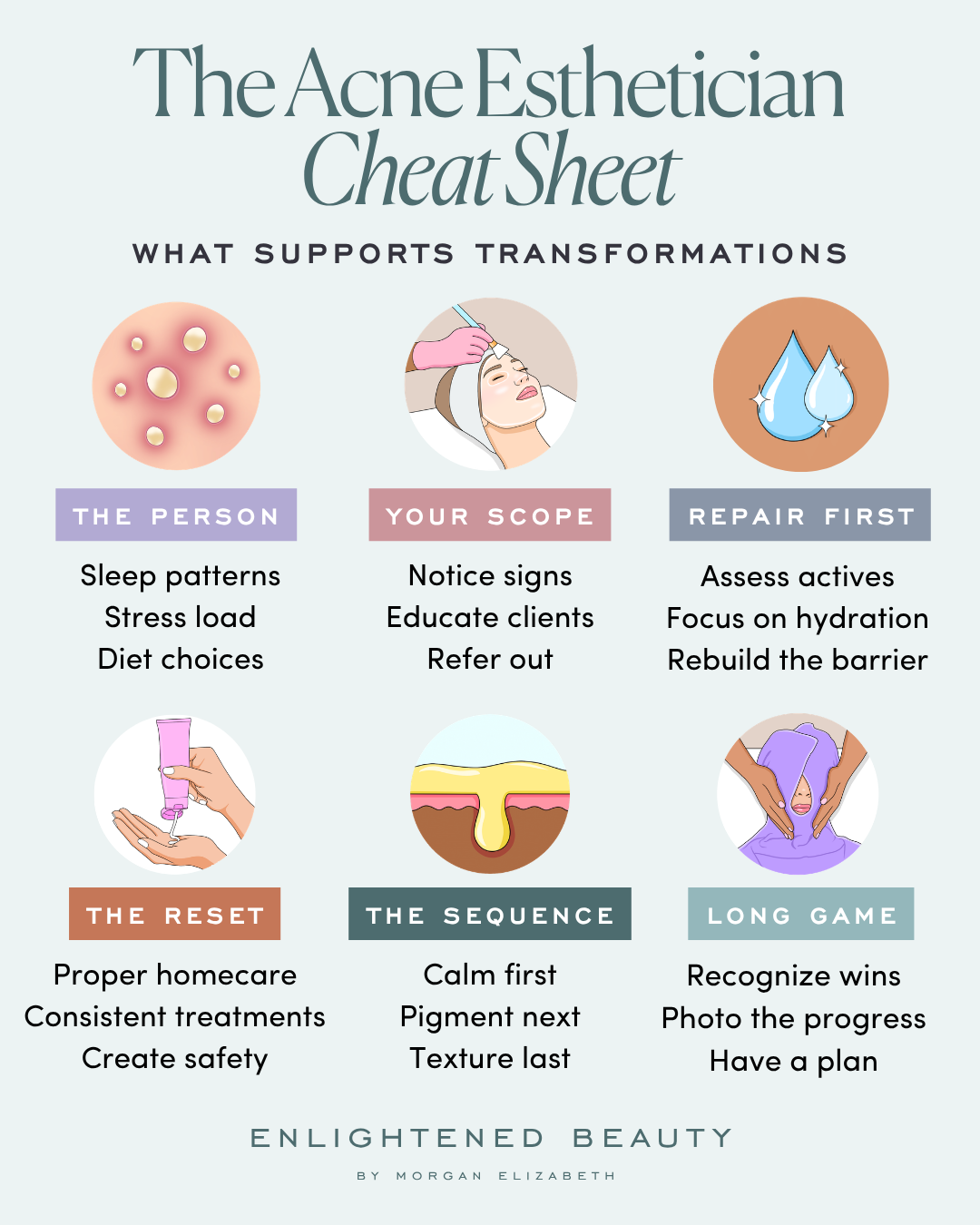
If there's anything I've found, it's this: a breakout is information. Once you start educating yourself on the deeper root causes of acne and then start asking your clients deeper intake questions, you're able to read them as a whole person, not just what you see on the surface, and that's when the patterns start to appear. When a person sits down in my treatment room, their skin is telling me something about what's happening underneath, and my job is to take in the whole picture before I decide on a single product or treatment.
So I pay attention to the things that are easy to skip past. How someone has been sleeping. What their stress has looked like lately. How their digestion feels, where they're at in their cycle, just to name a few. The questions I ask at the very beginning tell me more than my eyes ever will, and they usually shape the plan long before I ever reach for an active. The estheticians who grow the fastest are the ones who stay genuinely curious about the person on their treatment bed (and I mean the whole person, their habits, their patterns, their life). When you learn to read the skin the way you read a story, the guesswork starts to fall away.
Acne is not random, even when it feels that way to the person living with it. Over time, I started to see the same stories repeat:
Hormonal breakouts settling along the jaw and chin, moving with someone's cycle
Congestion that traced back to what someone was eating
Inflammation that flared right alongside their stress
None of this is me diagnosing anything, it's just a simple ability to recognize patterns and use them to ask better questions that allow me to educate my clients on what might be worth a closer look. When you can tell the difference between acne that's driven from the inside and acne that's mostly topical, you stop just throwing products at the surface like it's spaghetti at a wall, hoping something sticks. You start meeting the skin where the issue actually lives, and that shift, learning to understand why the skin is doing what it's doing, is the heart of how I approach every acne client. It's made all the difference in our success.
Lesson 2: Learning to identify, educate, and when to refer out
When many imagine approaching esthetics from a holistic place, they assume you're automatically going out of scope. I'm here to debunk that. As estheticians, we are not here to diagnose, prescribe, or even hand out nutritional plans. Our work is to recognize what the skin is showing us, to educate our clients on what might be contributing, and to know when something might actually be out of our scope. Knowing when to step back and refer out is another underrated skill of a skilled esthetician.
When I start to notice signs that point to something deeper, whether it be a hormonal imbalance, a gut issue, disordered eating, or a mental health struggle showing up on the skin, I don't try to solve it all inside my treatment room. I gently share what I'm noticing, I educate where I can, and I try to point my clients toward the right person.
Sometimes that looks like recommending someone see a therapist. Sometimes it's letting a client know it may be time to get lab work done so they can get real clarity on their hormones. A good referral tells your client you see the whole picture, and that you care about their healing more than your ego. When in doubt, refer out. It protects your client, it protects your license, and it builds the kind of trust that keeps people coming back.
Because sometimes, healing someone's skin takes an entire team. We're honored to be part of that team, and we don't have to act like we can solve everything on our own.
Lesson 3: Learning to repair before you correct
If I had to highlight the lesson that changed my results the most, it would honestly be this one. When someone comes to me inflamed, reactive, and desperate to fix their breakouts, every instinct says to reach for something strong, like an acid or a retinoid. But when the barrier isn't healthy, that approach tends to backfire, and I've watched it happen enough times to trust it completely.
So now I look for the signs first:
Skin that burns or stings from gentle products
Skin that never quite feels hydrated
Skin that flakes or stays red long after a treatment
Skin that feels tight and stripped after cleansing
When I see that, I pause the correction and put everything into repair. That means focusing on real hydration, barrier-supporting lipids, calming botanicals, and a routine simple enough to finally let the skin settle. Some of the most dramatic turnarounds I've seen actually came from doing less, not more. A compromised barrier can look a lot like acne, and learning to tell the two apart will change the way you treat.
Lesson 4: Learning to recognize when skin is stuck
Not all reactive skin is the same, and learning to tell the difference has saved me from a lot of wasted treatments. Some skin is simply stressed. It flares after a hard week, a red-eye flight, or a stretch of bad sleep, and it bounces back quickly once you support it with hydration, barrier care, and a calm, simple approach. Other times, the skin may seem a bit more stuck, meaning it stays inflamed for months, reacts to even the gentlest products, and tends to belong to the client who tells you, with real defeat in their voice, that "nothing works."
While these two can look similar on the surface, they do ask for completely different things from you. When skin is in that place, I slow everything down. Fewer steps, gentler choices, and honestly my own calm becomes a part of the treatment. Stress shows up on the skin more than most people realize, and sometimes the most healing thing I can offer is a sense of safety while the rest of the body catches up. Like I said before, you're not here to fix everything at once, but you can be there to help the skin feel safe enough to heal.
Lesson 5: Learning to treat peels as a sequence, not a service
Chemical peels are actually what I'm known for, and they're also what taught me the most patience. Early on, I considered a peel to be a single powerful treatment. Now I see it clearly as a sequence that unfolds over time, and I follow the same general progression with almost every acne client:
First, calm the inflammation
Then, treat the pigment left behind
Finally, refine the texture
Not every client reaches all three stages, and that's okay. The ones who do get there because we stayed consistent and respected the process instead of rushing through it or expecting change to happen after one peel.
The other thing I had to learn was restraint. A lot of estheticians might reach for an acid too soon. The question I ask myself before every peel is a simple one: what does the skin need today to feel safer and more supported? When there's any doubt, I start gentle. Acids have their place once the skin is stable and the client is consistent at home, and the real skill is reading the skin in front of you and meeting it where it is. If peels still feel intimidating, that's normal, and building real confidence with them is its own skill worth developing.
Lesson 6: Learning to support a client through slow progress
One of the hardest moments in acne work is the day a client is doing everything right and the skin still isn't where either of you hoped it would be. That's the moment a lot of estheticians lose confidence, and it's the moment a client starts to wonder if any of this is worth it or ever going to work. How you hold that conversation often decides whether they stay with you long enough to see the transformation through.
So I've learned to name progress out loud, because clients rarely see it on their own. Breakouts that are less inflamed, skin that heals faster between flare-ups, texture that's slowly evening out. Those wins are real even before the clear-skin moment arrives. This is also why I try to document everything. When a client can look back at a photo from where they started, the side-by-side says what words often can't.
I've also made peace with adjusting the plan. When something isn't working, I change it, and I've learned to frame that as part of the process rather than a failure. We learn from the skin as we go, and the plan evolves with it. So it’s important to remember that healing is not linear, progress is not perfection, and the clients who understand that are going to be the ones who stay long enough to get there. Your job is to hold that truth for them until they can hold it themselves.
Frequently asked questions
How can you tell if a client's acne is hormonal?
Hormonal breakouts tend to settle along the jaw, chin, and neck, run deep, and move with someone's cycle. Noticing that helps you ask better questions and know when to suggest they see a provider. It's important to know that this is just a method of recognition, not providing a diagnosis.
Do you need to understand nutrition and gut health to treat acne?
While it's not a requirement, I encourage estheticians to learn enough about nutrition and gut health to help them recognize patterns and educate their clients beyond just recommending treatments and products.
What's the most common mistake newer acne estheticians make?
Correcting before repairing. When the barrier is compromised, reaching for strong actives usually sets the skin back, so slowing down and repairing first is what makes everything after it work.
Final Thoughts
If there's a thread running through all six of these, it's this: treating acne well comes down to how you think. Reading the whole person, staying in your scope, protecting the barrier, recognizing what the skin is really asking for, respecting the process, and walking with someone through the slow parts. None of it happened overnight for me, it came together over years of paying attention, and eventually it became a methodology I could teach. That's what the Enlightened Acne Method is: everything a decade in the treatment room taught me, organized into something other estheticians can learn and lean on.
If my thought process around acne resonates with you, there are two ways to go deeper with me. The Enlightened Acne Method is my full methodology in a self-paced form: my assessment process, how I approach peels, and the client frameworks I've built over the years. And if you want more hands-on support, my mentorship is where we work together directly, so I can help you apply all of this in your own room, with your own clients. Both are built for estheticians who want to treat acne holistically and start seeing real results.
Keep Reading
The lessons nine years of building an acne practice taught me, the ones that stuck.
✧ ✧ ✧
The books, mentors, and tools that shaped how I grew as a holistic esthetician.
✧ ✧ ✧
A foundational walk through how I approach treating acne, start to finish.
stay radiant,
— Morgan
About the studio
Enlightened Beauty
A holistic skincare studio in Sacramento, California, founded by esthetician Morgan Cameron in 2016. The studio specializes in acne treatment, chemical peels, and whole-person skincare that supports skin health from the inside out, pairing professional treatments with coaching on the foundations that keep skin clear: sleep, stress, gut health, and hydration.
Meet the Team