
Cortisol and Acne: What's Actually Happening Inside Your Skin When You're Stressed
One of the most common things I hear from clients is some version of, "I was doing fine, and then everything just flared up." And when I ask what was going on in their life 60 to 90 days before the breakouts started, it almost always clicks. A move, a breakup, a new job, finals, a loss...something shifted, and the skin followed.
That connection between stress and breakouts isn't in your head. It's in your biology, and cortisol is the mechanism driving it.
If you're new here, hi! I'm Morgan Cameron, esthetician and founder of Enlightened Beauty in Sacramento, and I've spent the last decade treating acne holistically, which means I'm looking at way more than just your face.
So let's talk about what's actually happening inside your body when stress starts showing up on your skin.
What Cortisol Actually Does to Your Skin
Stress breakouts, meet your architect. Cortisol is your body's primary stress hormone. It's produced by your adrenal glands, and in small doses it can actually be helpful. It has great use cases, like regulating your sleep-wake cycle, managing inflammation, and helping your body respond to acute threats.
The problem is that most of us aren't dealing with acute threats. We're dealing with chronic ones. Deadlines that don't end, relationships that drain us, sleep that never quite feels like enough. And when the stress doesn't let up, neither does the cortisol.
Here's what happens in the skin when cortisol stays elevated:
Your sebaceous glands go into overdrive. Cortisol signals your oil glands to produce more sebum. And I don't mean just a little more, it's usually noticeably more. That excess oil changes the environment inside your pores, making it easier for bacteria to thrive and harder for your skin to stay balanced.
Inflammation increases. Cortisol in small bursts is anti-inflammatory. But chronically elevated cortisol actually does the opposite. It disrupts your skin's immune response, which means breakouts show up more inflamed, more painful, and slower to heal. Those deep, tender spots along your chin and jawline that seem to come out of nowhere? This is often what's underneath.
Your skin barrier weakens. Prolonged stress compromises the lipid barrier that keeps moisture in and irritants out. When that barrier is compromised, your skin becomes more reactive, more sensitive, and more vulnerable to the very products and treatments that are supposed to help. I've had clients come in with skin that stings from their gentlest cleanser, and the root cause wasn't the product, it was their nervous system.
Cell turnover slows down. A lot of people don't realize that stress affects how quickly your skin regenerates. This means dead skin cells hang around longer than they should, which also means congestion, clogged pores, and buildup sitting on the surface.
Insulin and blood sugar get involved. Here's where it gets fun (and by fun, I mean annoying). Cortisol raises your blood sugar. Your body responds by pumping out insulin. Insulin ramps up androgen activity, and androgens tell your oil glands to produce even more sebum. So now you've got cortisol and your blood sugar working against you when you don't play your cards right. (Sugar does more than just trigger breakouts, by the way. It also accelerates aging in the skin.) If you've ever noticed your skin getting worse when you're stressed and repeatedly reaching for the candy drawer at 3pm, this is the loop you're living in. Stress changes how we eat, and what we eat feeds the cycle right back.
Why Topical Treatments Alone Won't Solve Stress Acne
Here's the truth, you can do the best treatments in the world and still not get the results you're looking for if these internal systems are out of balance.
When a client comes in with active, inflamed breakouts and I can tell from their intake form, or just from talking to them, that they're running on high cortisol, the last thing I'm going to do is pile on aggressive actives. That approach almost always backfires on stressed skin, because the barrier is already compromised and the inflammation is already running hot.
Instead, I slow everything down. I focus on calming the inflammation first, supporting the barrier, and having an honest conversation about what's going on beyond the skin. That might mean starting with an enzyme exfoliation or LED light therapy instead of jumping straight to a chemical peel, because stressed skin needs to be met where it is. I ask about sleep quality, stress levels, how often they're moving their body, whether they're skipping meals or going long stretches without eating. Those questions matter just as much as what they're putting on their face, sometimes more.
I think of it like what I call the yoga effect. When someone starts yoga, they naturally start drinking more water, they eat a little better, they sleep a little more intentionally. One healthy habit pulls the next one forward. Skincare works the same way. When a client commits to a home care routine and starts showing up for their treatments, they naturally start paying attention to the rest of their life, too. And the skin responds to all of it.
Stressed Skin vs. Something Deeper
Not every stressed-out client is the same. There's a real difference between skin that's temporarily reactive and skin that's stuck.
Stressed skin looks like breakouts that track with what's happening in someone's life. Whether it's a rough week at work, a stretch of bad sleep, or getting thrown off by travel, the skin is going to respond. The skin flares, but once the stressor passes and the routine gets back on track, it bounces back. In these cases, it usually responds really well to hydration, barrier repair, and calming treatments like our Glacial Glow facial or a gentle enzyme exfoliation.
Then there's what I call "Trauma Skin", which usually looks like chronic inflammation that lingers for months, and sensitivity even to the gentlest products. Most common with clients who say "nothing works" and feel emotionally defeated by their skin. This is skin that doesn't improve until the nervous system starts to settle, and that takes more than a good serum.
When I recognize that pattern, I don't add more, I make it a point to simplify. Fewer steps. More presence. Because you're not going to correct skin that's in a state of chronic stress by layering on more correction. You have to help the skin feel safe again first.
The 60 to 90 Day Window
One thing I always tell my clients: your skin today is telling you what was happening in your body and your life two to three months ago. Breakouts that seem random usually aren't, they just have a delayed timeline.
So when a client says "my skin's been normally pretty good but last summer I started getting some breakouts and it just hasn't stopped," I'll ask, okay, let's talk about what happened 60 to 90 days before that. Did you move? Graduate? Go through a breakup? Start a new medication? Change your birth control?
That conversation opens up more than any product recommendation ever could. Because once someone connects the dots between their life and their skin, they stop treating breakouts like a mystery and start treating them like information worth investigating. And that shift in perspective changes everything about how they approach their care.
What Actually Helps
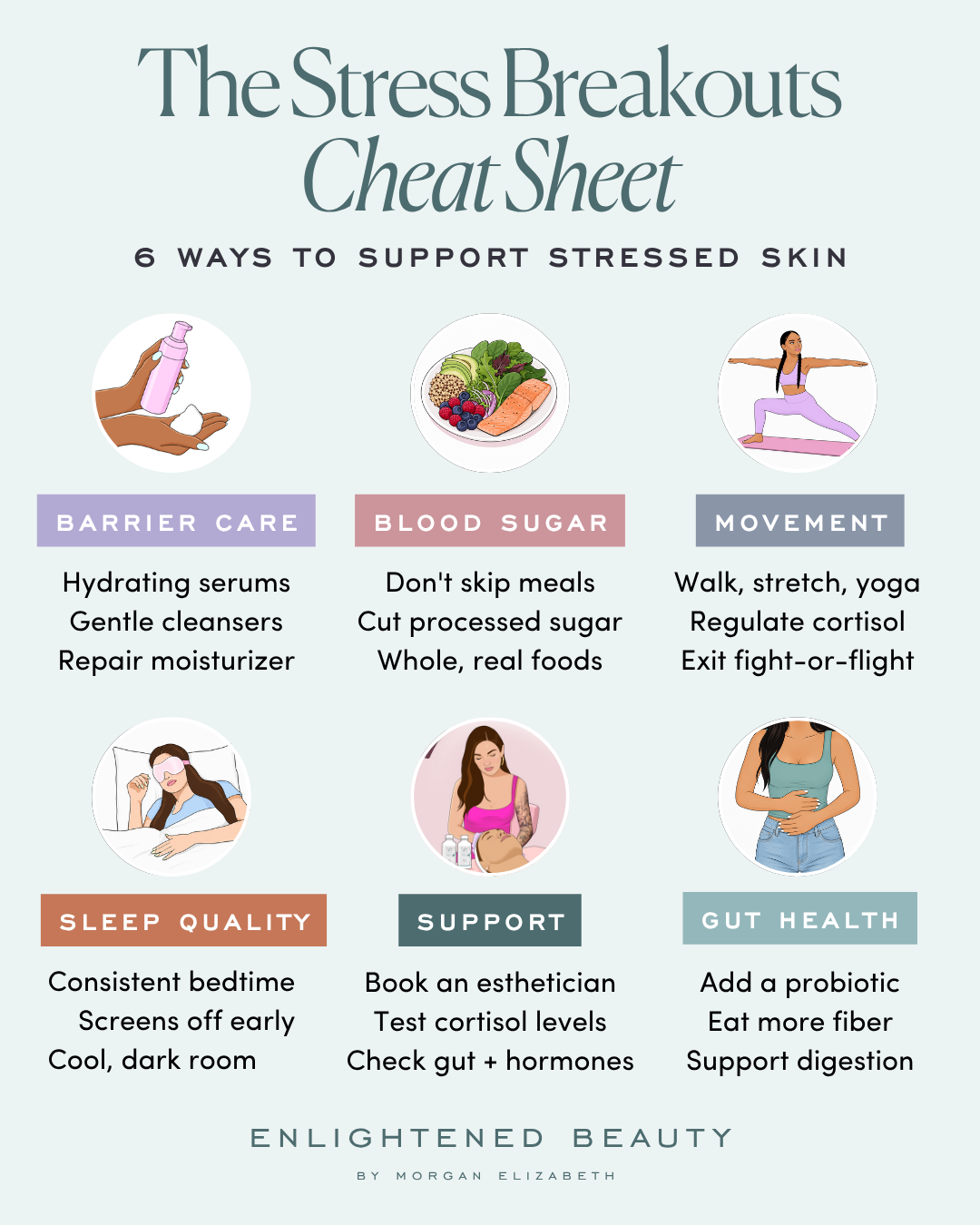
If you're dealing with stress-related breakouts, here's where I'd start:
Protect your barrier. When your skin is stressed, it needs support before it needs correction. Hydrating serums, gentle cleansers, barrier-repair moisturizers. Resist the urge to strip your skin or add more actives when it's already inflamed. (If you're not sure where to start, our Barrier Repair Starter Kit is built for exactly this. I also love the Epicutis Hyvia Creme for deep hydration and barrier support in one step.)
Look at your blood sugar. Cortisol and insulin are connected, and what you eat matters more than most people realize. Eating consistently throughout the day, reducing processed sugar, and prioritizing anti-inflammatory foods can help interrupt the cortisol-insulin loop.
Move your body. Exercise is one of the most effective ways to regulate cortisol. It doesn't need to be intense. Walking, yoga, stretching. Anything that helps your nervous system shift out of fight-or-flight.
Address your sleep. Your skin does its deepest repair overnight. When sleep is compromised, so is that repair cycle. If your sleep quality has been off, that's one of the first things worth addressing.
Work with a professional. And I don't just mean an esthetician, though I'd obviously love to see you. If you suspect your cortisol levels are consistently elevated, that's worth exploring with a naturopath or your doctor. There are ways to test for it, and sometimes the skin is telling you something that goes beyond what topical care can reach.
Consider your gut health. Stress directly impacts your gut microbiome, and your gut and your skin are in constant communication. When one is off, the other usually follows. I carry the Kuma Glow Biome Probiotic at the studio for exactly this reason. It delivers 15 billion CFU across six targeted strains, and one of them (L. rhamnosus SP1) has been clinically shown to normalize insulin signaling in the skin, which ties directly back to that cortisol-insulin loop we talked about earlier.
The Bigger Picture
Acne isn't just a skin condition. It's a whole-body conversation. And cortisol is one of the loudest voices in that conversation, especially for people who feel like they're doing everything "right" topically and still breaking out.
The clients who see the most significant transformations at Enlightened Beauty aren't the ones with the most aggressive treatment plans. They're the ones who understand that clearing their skin is a collaboration. It takes two. It's what I tell every new client who sits in my treatment room: I can take you far, but if you're not listening to the recommendations, not doing your home care, not looking at how stress and sleep and food are showing up in your life, we're both going to be on a hamster wheel.
Once someone gets that, truly gets it, everything shifts. Watching that shift happen, watching a client go from frustrated and defeated to empowered and in tune with their own body, is the reason I do what I do.
Ready to get to the root of your breakouts? Book a consultation at Enlightened Beauty in Sacramento. Every new client starts with a holistic intake that goes beyond the surface, so we can build a plan that actually works with your body, not against it.
Frequently Asked Questions
How does stress cause acne?
Stress triggers your adrenal glands to produce cortisol, your body's primary stress hormone. When cortisol stays elevated, it increases oil production in your sebaceous glands, weakens your skin barrier, slows cell turnover, and raises blood sugar, all of which create conditions for breakouts.
Can cortisol levels directly cause breakouts?
Yes. Chronically elevated cortisol stimulates excess sebum production and increases inflammation in the skin. It also raises insulin levels, which triggers androgen activity, leading to even more oil production. This creates a cycle that can keep acne active even when someone's topical routine is solid.
What does stress acne look like?
Stress-related breakouts tend to show up as deep, inflamed, painful spots, often along the chin, jawline, and lower face. The skin may also feel more reactive or sensitive than usual. Unlike typical breakouts that respond to targeted treatment, stress acne often persists until the underlying stressors or cortisol levels are addressed.
How long does it take for stress to show up on your skin?
Skin changes typically reflect what was happening in your body 60 to 90 days prior. So a stressful period in the spring might show up as breakouts in the summer. This delayed timeline is why stress breakouts can feel random when they're actually following a pattern.
What's the best way to treat stress-related acne?
A holistic approach works best. That means protecting the skin barrier, managing blood sugar and diet, regulating sleep, moving the body, and working with professionals who look beyond the surface. At Enlightened Beauty in Sacramento, Morgan Cameron uses a holistic intake process that evaluates stress levels, sleep quality, hormonal health, and lifestyle alongside skin analysis to build a treatment plan that addresses the full picture.
Is stress acne the same as hormonal acne?
They overlap significantly. Cortisol is a hormone, and chronic stress affects the entire endocrine system, including testosterone, progesterone, and insulin. Many clients dealing with what they think is purely hormonal acne are also dealing with a cortisol component. Addressing both often leads to faster, more lasting improvement.
Keep Reading
How stress shows up on your skin, and why the mental side of clearing matters.
✧ ✧ ✧
What a compromised barrier actually looks like, and the steps to rebuild it.
✧ ✧ ✧
The connection between blood sugar, insulin, and breakouts, explained.
✧ ✧ ✧
Your gut and your skin are in constant conversation. Here's what that means for acne.
About the studio
Enlightened Beauty
A holistic skincare studio in Sacramento, California, founded by esthetician Morgan Cameron in 2016. The studio specializes in acne treatment, chemical peels, and whole-person skincare that supports skin health from the inside out, pairing professional treatments with coaching on the foundations that keep skin clear: sleep, stress, gut health, and hydration.
Meet the Team